Table of Contents
Mastering the nuances of Discurso Direto e Indireto Ingles is essential for any learner who wants to move beyond basic translation and express themselves with precision and authenticity. This journey transforms how you report speech, shifting from simply quoting words to thoughtfully reshaping them to fit your narrative context.
Understanding the Core Concept of Direct and Indirect Speech
At its heart, the distinction between Discurso Direto e Indireto Ingles is about perspective and timing. Direct speech, or quoted speech, places the speaker's exact words inside quotation marks, preserving their original tone, vocabulary, and punctuation. It feels immediate and vivid, as if the listener is hearing the voice right now. Indirect speech, often called reported speech or narration, steps back and paraphrases the message. It integrates the content into the grammar of your own sentence, which allows you to adjust the message for clarity, relevance, or to align with the time when you are speaking, not when the original words were spoken.
Consider the difference between yelling "Look out!" and calmly telling someone that the teacher warned everyone to be careful. The first is an urgent moment captured in time; the second is a calm transmission of information. This fundamental shift requires more than just changing the verb; it demands a thoughtful adjustment of the entire grammatical ecosystem surrounding the verb, including pronouns, adverbials of time and place, and sometimes even the underlying logic of the sentence.
The Grammatical Shifts That Define Indirect Speech
The most visible feature of Discurso Direto e Indireto Ingles is the change in verb tense. When reporting a statement that was originally in the simple present, you typically shift to the simple past. A present perfect often becomes a past perfect, and a past continuous becomes a past perfect continuous. This "backshifting" signals that the event or state belongs to a prior frame of reference.
- Direct: She says, "I love chocolate."
- Indirect: She said that she loved chocolate.
Beyond tense, pronouns and possessives must be adjusted to maintain logical reference. The speaker on the receiving end must decide whose perspective the pronouns represent. If the original speaker said "I," the reported version might become "she" or "he" depending on who is doing the reporting. Similarly, time and place words like today, now, here, and yesterday are highly flexible and often shift to that day, then, there, or the following week to keep the narrative coherent.
Pronouns and Adverbials: The Hidden Architecture
Pronouns are the glue that holds reported speech together, but they are also a common source of confusion. In Discurso Direto e Indireto Ingles, you must ensure that the pronoun in the indirect clause clearly points to the correct person. Ambiguity arises when multiple people are involved, so it is often better to repeat the noun or use a clarifying phrase rather than risk confusion with a vague pronoun.
Adverbials of time and location act as temporal and spatial anchors. When these anchors shift, the entire context of the event changes. For example, "I am working here" becomes "She explained that she was working there." This subtle change in location word preserves the meaning while respecting the new spatial relationship between the speaker, the listener, and the scene of the action.
Modal Verbs and Special Cases in Reporting
Modal verbs like can, will, shall, and should follow their own set of rules in the realm of Discurso Direto e Indireto Ingles. Often, these verbs soften their intensity to reflect the distance of the report. "Can" might become "could," "will" might become "would," and "must" can stay as "must" if the obligation is seen as absolute and timeless, though "had to" is also frequently used to emphasize the pressure of the original command.
Questions and imperatives require special handling. Yes/no questions typically introduce a structure using if or whether, while wh- questions use the appropriate question word but drop the inversion of subject and verb. Commands, which are direct instructions, are usually converted into noun clauses using verbs like tell, ask, or order, followed by an infinitive without to.
The Role of Time and Truth in Indirect Discourse
One of the most fascinating aspects of Discurso Direto e Indireto Ingles is how it handles the concept of truth and the present moment. If a statement is a universal truth or a firm fact, the tense may remain unchanged even though the reporting verb is in the past. You can say, "The teacher explained that the Earth goes around the sun," because the fact is eternal.
Similarly, if the reported statement is still true at the time of reporting, it is sometimes acceptable to keep the present tense to emphasize its current validity. However, in most conversational contexts, the shift in tense helps the listener subconsciously timestamp the information, distinguishing between a memory, a prediction, or a current reality.
Related Videos
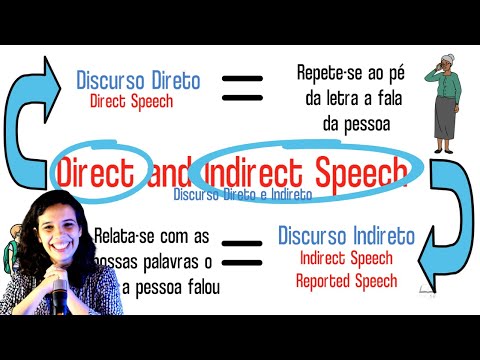
Discurso Direto e Indireto em Inglês - Aprenda a gramática do Inglês de forma fácil e descomplicada
EnglishBible Link do livro de gramática: https://sun.eduzz.com/650788 Quer saber mais sobre o meu curso completo de inglês ...
Practical Tips for Mastery
Developing a natural feel for Discurso Direto e Indireto Ingles requires active listening and deliberate practice. When you are reading or watching English content, try to identify the moments where the narrative shifts from direct quotes to reported speech. Notice how the verbs adjust and how the surrounding context changes to support the new structure.
When speaking or writing, focus on the intention behind the message. Do you want to capture the raw energy of the moment with direct speech, or are you summarizing a conversation for clarity with indirect speech? Practicing this choice consciously will help you internalize the grammar rules until they feel intuitive, allowing you to navigate the complexities of English narrative with confidence.
In conclusion, understanding Discurso Direto e Indireto Ingles is a milestone in language proficiency that unlocks a deeper level of communication. By paying attention to the subtle shifts in tense, pronoun, and adverbial logic, you move beyond simple vocabulary exchange and start thinking like a native speaker, capable of shaping your narrative with precision and nuance.
